The Vital Safety Role of High-Performance Braking
Brakes are the single most critical safety component on any high-speed electric off-road vehicle. When traveling at trail and highway speeds on a 50–85 kg machine, kinetic energy increases exponentially with speed ($E_k = \frac{1}{2}mv^2$).
Unlike gas dirt bikes that offer substantial engine compression braking when closing the throttle, electric dirt bikes with mild regenerative braking rely almost entirely on their hydraulic disc brake systems to shed speed. High-performance riding down steep mountain descents generates immense thermal energy that can quickly overwhelm stock braking components, causing dangerous lever fade.
Factory Brake Limitations & Thermal Fade
Stock braking systems derived from bicycle standards suffer from critical thermal and mechanical limitations:
- Severe Brake Fade: Standard organic/resin pads glaze over when heated above 200°C, causing sudden loss of frictional bite and forcing the rider to squeeze the lever with maximum force.
- Rotor Warping & Runout: Thin 1.8mm to 2.0mm stock rotors warp under thermal expansion, causing pulsating levers, noisy brake rub, and uneven pad wear.
- Fluid Boiling & Lever Pump: Excessive heat conducted through the caliper pistons boils mineral or DOT hydraulic brake fluid, introducing compressible gas bubbles that cause the brake lever to pull all the way to the handlebar grip.
- Rapid Pad Wear: Soft organic resin pads wear out in just a few wet or muddy rides.
- Caliper Piston Sticking: Bicycle-style dual-piston calipers suffer from uneven piston retraction when coated in trail grit.
What to Look for in Brake Upgrades
Upgrading your braking system delivers immediate stopping power and safety:
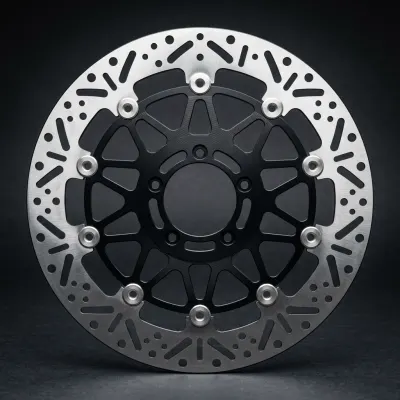
- Warp 9 Oversized 220mm Floating Rotor Kit (SKU: SR-WAR-0016):
- Mechanical Leverage: Increasing rotor diameter from stock 203mm to 220mm expands the effective braking radius, providing approximately 15% more mechanical stopping torque with less hand effort.
- Floating Carrier Architecture: The 410 stainless steel outer friction ring is connected to an aluminum inner carrier via stainless rivets, allowing the rotor to expand radially under high heat without warping.
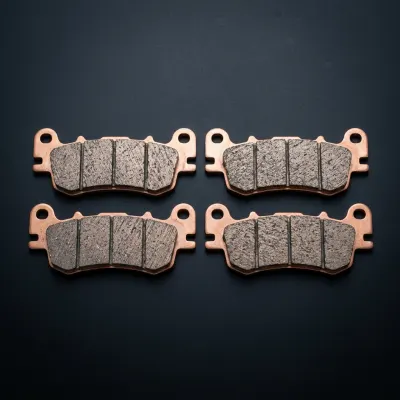
- GritShift Sintered Brake Pad Set Front & Rear (SKU: SR-GRI-0017):
- Frictional Stability: Formulated from pressed copper and metallic particles that resist temperatures exceeding 600°C without glazing or fading.
- Durability: Sintered metallic pads last 2x to 3x longer than resin pads in wet, muddy, and sandy conditions.
Companion Upgrades & Bleeding/Bedding Procedures
Proper installation and maintenance are essential for braking safety:
- Heat Bedding Procedure: Always bed in new pads and rotors before hard riding. Perform 10–15 moderate stops from 20 mph down to 5 mph without coming to a complete stop, followed by 5 firm stops to transfer a microscopic, uniform layer of friction material to the rotor track.
- High-Temperature Brake Fluid Flush: Periodically flush and bleed hydraulic brake lines with high-boiling-point fluid (DOT 4/5.1 or high-performance mineral oil depending on your caliper specification).
- Rotor Caliper Alignment: Ensure the caliper relocation bracket is torqued securely (8–10 Nm with blue threadlocker) and the rotor runs centered between the brake pads.
Brake Systems FAQ
What is the main advantage of a floating brake rotor over a solid rotor?
A floating rotor allows the outer steel braking ring to expand and contract independently from the aluminum center hub under extreme heat, preventing thermal warping and dish distortion.
Why are sintered brake pads noisier than resin pads, and is that normal?
Sintered pads contain metallic copper and bronze particles that produce a slight metallic hiss during hard braking. This is completely normal and is the trade-off for extreme fade resistance and wet-weather bite.
Do I need a new brake caliper to run a 220mm rotor?
No. The Warp 9 220mm kit includes a precision CNC caliper relocation bracket that spaces your existing caliper outward to perfectly align with the larger 220mm rotor diameter.
How can I tell when my brake pads need replacement?
Inspect pad thickness regularly. When the friction material wears down to less than 1.0mm thickness (roughly the thickness of a credit card), replace the pads immediately to prevent metal backing plate contact with the rotor.
Can I use automotive brake cleaner on my electric dirt bike rotors?
Yes. Use residue-free isopropyl alcohol or dedicated motorcycle disc brake cleaner to clean rotors and calipers. Never spray chain lube or silicone sprays near braking surfaces.
Why does brake fluid need to be flushed periodically?
Hydraulic brake fluid absorbs atmospheric moisture over time, lowering its boiling point and causing spongy brake lever feel during heavy downhill braking.