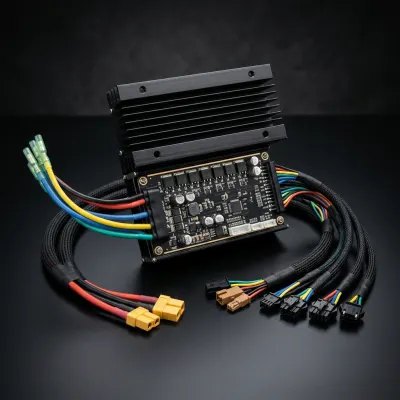
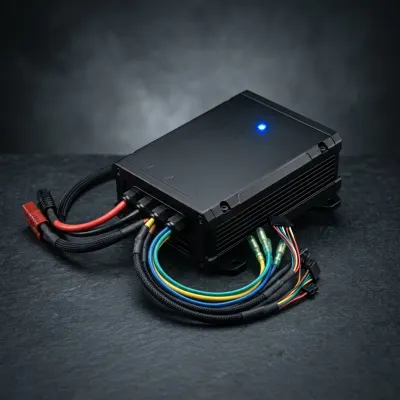
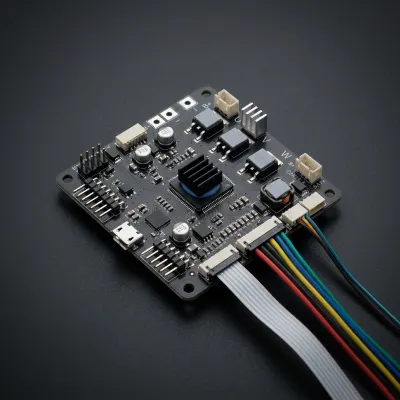
The Critical Role of the Controller in Electric Dirt Bikes
On an electric off-road motorcycle, the motor controller is the central nervous system and powertrain brain of the entire machine. It acts as an ultra-high-speed computational bridge connecting the high-capacity lithium battery pack, the rider's electronic throttle input, and the three-phase brushless DC (BLDC) or permanent magnet synchronous motor (PMSM).
Unlike traditional internal combustion dirt bikes that modulate engine output through mechanical slide carburetors, throttle butterflies, and multi-speed manual gearboxes, an electric dirt bike relies 100% on the controller's solid-state MOSFET switching speed, vector commutation algorithms, and thermal management. At millisecond intervals, the controller calculates rotor position via Hall effect sensors or encoder feedback and pulses hundreds of amps of phase current to produce immediate, linear torque. The controller also manages regenerative braking deceleration, regulates field weakening to extend high-RPM speed, monitors motor stator temperature, and safeguards the lithium cells against over-current damage.
Stock Controller Limitations & Common Failure Modes
While factory Sur-Ron controllers provide safe, predictable performance for entry-level trail riding, they represent the single biggest bottleneck preventing the chassis and motor from achieving their full potential:
- Phase Current Clamping: Factory controllers restrict continuous phase current to approximately 90A–120A, resulting in sluggish hill-climb acceleration, laggy low-speed roll-on, and limited high-speed pulling power.
- Aggressive Thermal Throttling: The stock cast housing has limited thermal mass and cooling fin surface area. Under sustained high loads (such as steep mountain ascents, deep sand, or hot summer trail rides), the internal thermal protection circuit aggressively rolls back power by 50% or more to prevent MOSFET meltdown, leaving riders stranded on steep inclines.
- Primitive Commutation & Throttle Jerk: Factory units utilize basic trapezoidal or rudimentary sine-wave switching, which creates an abrupt on/off jerk at low speeds, harsh torque step-ups, and audible electromagnetic motor hum.
- Zero User Tunability: The stock controller cannot be recalibrated for custom throttle response curves, adjustable regenerative braking percentages, reverse functions, or higher-voltage 72V aftermarket batteries.
What to Look for When Choosing an Upgraded Controller
When evaluating aftermarket controller upgrades like the EBMX X-9000, KO Moto Beast V2, or Nucular 12F, evaluate these vital engineering criteria:
- Field-Oriented Control (FOC) Architecture: Ensure the controller utilizes 32-bit vector FOC algorithms. Sinusoidal commutation feeds smooth, pure sine-wave current into motor windings synchronized with real-time rotor angle, eliminating motor hum, reducing stator heat generation, and delivering surgical throttle modulation.
- Continuous vs. Peak Amperage Ratings: Scrutinize both battery current (DC drawn from the pack) and phase current (AC fed to the motor windings). Look for units capable of at least 300A to 500A peak phase current to ensure rapid torque delivery without voltage collapse.
- Thermal Dissipation & Heatsink Quality: Choose controllers housed in solid CNC-machined 6061-T6 aluminum heatsinks with deep external cooling fins designed for high convective airflow through the frame.
- Bluetooth & Telemetry Connectivity: Wireless smartphone integration or dedicated handlebar displays allow you to fine-tune throttle ramping, speed limits, field weakening RPM extension, and regenerative braking on the fly without carrying a laptop to the trail.
Companion Upgrades & System Synergy
A high-power controller upgrade fundamentally transforms your bike's electrical and mechanical demands. To ensure optimal performance and reliability, consider these companion modifications:
- High-Discharge 72V Battery Pack: While top controllers like the EBMX X-9000 can safely run on the stock 60V battery, upgrading to a 72V pack (such as the Luna Cycle 72V) is required to unlock full 10kW to 15kW+ outputs without voltage sag.
- Heavy-Duty DC Circuit Breaker: The factory 32A/40A breaker will trip under the sustained current draw of an upgraded controller; upgrading to a 63A or 80A rated DC breaker prevents nuisance tripping during aggressive full-throttle pulls.
- Heavy-Duty 420-Pitch Race Chain: The instant torque of an upgraded controller will rapidly stretch or snap stock non-sealed chains; pairing with an EBMX Gold Race chain kit is strongly advised.
- Thermal Heatsink Paste: Always apply high-grade non-conductive thermal paste between the controller backplate and the aluminum frame mount to maximize conductive heat transfer into the chassis.
Controllers & Electronics FAQ
Can I install an upgraded controller while still using my factory 60V battery?
Yes. Upgraded controllers like the EBMX X-9000 and KO Beast V2 have pre-configured profiles for the stock 60V battery, unlocking smoother throttle response, better low-end torque, and increased efficiency without damaging the stock pack.
What is Field Weakening, and how does it increase top-end speed?
Field weakening injects an opposing magnetic vector to counteract the motor's back-EMF at high RPM, allowing the motor to spin past its base voltage limit and significantly extending top-end speed.
How does regenerative braking work on an aftermarket controller?
During deceleration, the controller uses the motor as a generator to slow the rear wheel while recharging the battery. Damping strength can be customized via mobile apps, significantly reducing rear brake pad wear on long descents.
Is professional installation required for controller upgrade kits?
Our kits feature plug-and-play wiring harnesses matching OEM connectors, allowing installation in under 45 minutes with basic hex tools. Always disconnect the main battery and cycle the ignition to discharge capacitors before working on electrical components.
What is the difference between phase amps and battery amps?
Battery amps represent the total DC current drawn from the lithium battery, while phase amps represent the AC current multiplied by the controller MOSFETs and delivered to the motor windings, directly dictating low-speed torque.